A Day in the Life of Airport Operations — The AERO-Simple Way

At 6:00 a.m., airport operations teams walk into an operation that is already in motion. Overnight inspections are complete, maintenance activity may still be open, weather conditions are shifting, and aircraft movements are underway. Decisions need to be made immediately—and those decisions are only as good as the information behind them.
Airport operations have always been complex. Inspections, maintenance coordination, safety oversight, and regulatory compliance are not new challenges. What has changed is the expectation that all of this work stays aligned, visible, and auditable while the operation continues to move. That expectation cannot be met with disconnected tools, manual updates, or uncontrolled access to information.
This is where Airport Operations Management Software becomes critical—not as another system to manage, but as the integrated foundation that keeps daily operations under control.
Before: When the Day Is Held Together by Workarounds
- Morning handovers depend on reconstruction instead of clarity. Overnight findings, open discrepancies, weather impacts, and planned activities are reviewed using paper logs, spreadsheets, emails, and verbal updates. Access to information is inconsistent, forcing supervisors to piece together context before they can set priorities. Even when basic Airport operations software exists, the lack of integration across roles creates uncertainty from the first hour of the shift.
- Inspections are completed efficiently, but accountability weakens after the fact. Airfield inspections are carried out on time, yet documentation relies on paper or disconnected tools instead of structured Airport inspections software. Observations are handwritten, photos live on separate devices, and follow-ups depend on memory and manual reminders. Ownership is implied rather than enforced, and visibility depends on who happens to be informed.
- Midday coordination turns into status chasing. Inspection findings become action items that require maintenance and safety involvement, but updates move through calls and emails instead of real-time visibility. Operations teams repeatedly check the status just to confirm progress. Without an integrated work order management system for airports, effort is spent managing information rather than resolving issues.
- Compliance is handled as a separate, end-of-shift activity. Records are gathered from multiple sources, evidence is reviewed manually, and reporting is completed under time pressure. The operation continues to function—but only because teams apply constant effort to keep information aligned.
This approach works, but it does not scale. And it leaves little room for error.
After: When the Day Becomes AERO-Simple
This is where Aerosimple fits naturally into airport operations—not as another tool layered onto the process, but as an integrated operational environment where structure, visibility, and control are built in.
With Airport Operations Management Software designed specifically for airport workflows, the day stops feeling fragmented.
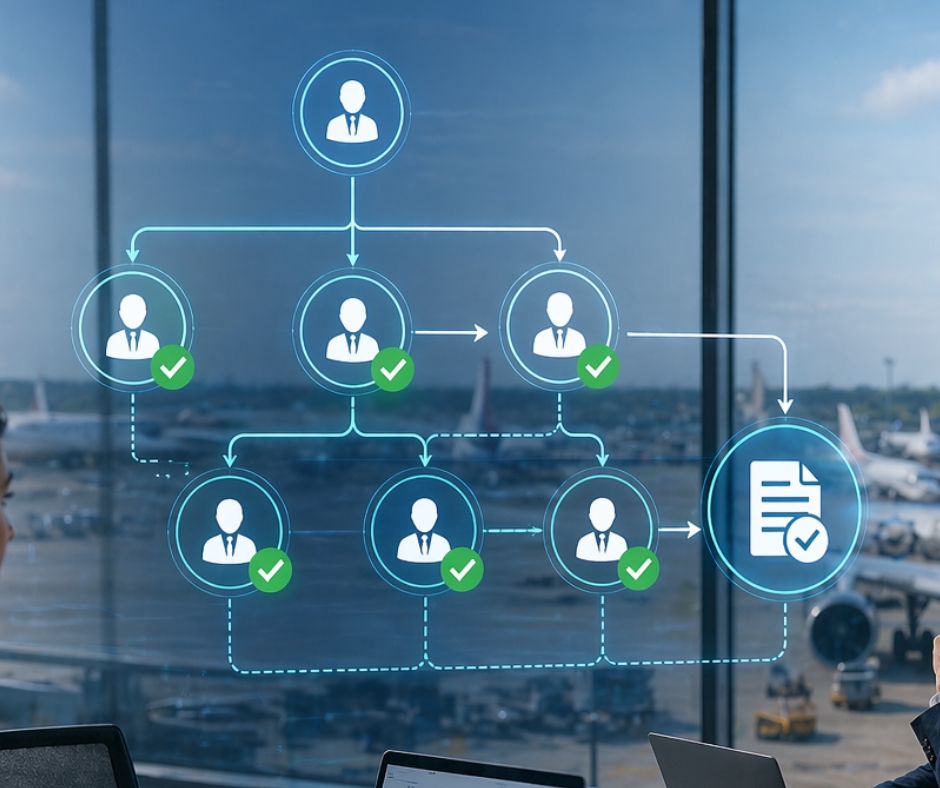
- Shift handovers begin with aligned, role-based visibility. Real-time operational information is available within a single integrated system. Inspectors see inspection tasks, maintenance teams see assigned work, supervisors see operational status, and leadership sees readiness and risk. Granular access ensures everyone sees exactly what they need—no more, no less—reducing noise and preventing blind spots.
- Inspections carry ownership from identification through closure. Inspections are completed digitally in the field, with observations, photos, and timestamps captured as the work happens. Issues are logged immediately and tracked within the same system. Permissions define who can update, escalate, or close findings, ensuring accountability is enforced by the workflow—not managed manually.
- Maintenance and operations work from a single, integrated view. Inspection findings flow directly into maintenance workflows with clear ownership and real-time updates. Maintenance teams update progress as work is completed, while operations teams maintain oversight without interrupting active tasks. Everyone works from the same information, within defined boundaries.
- Safety oversight is embedded into daily operations. Hazards, incidents, and corrective actions connect directly to inspections and maintenance activity, forming a structured airport safety management system. Safety teams maintain visibility without operational overreach, ensuring safety is part of decision-making—not an after-the-fact reporting exercise.
- End-of-shift handovers happen without pressure or uncertainty. Inspection records, maintenance history, compliance data, and safety actions are captured automatically and organized by responsibility. Handover to the next shift is consistent, controlled, and reliable, with audit readiness in place by default.
The complexity of airport operations does not disappear—but the friction does.
Managing the Airfield, Not the Information
Airport operations will always be demanding. The environment is regulated, dynamic, and unforgiving of misalignment. What can change is how much effort teams spend managing information instead of managing the airfield itself.
By replacing disconnected tools with integrated Airport Operations Management Software, complexity becomes manageable. Visibility improves. Accountability is clear. Teams operate with confidence instead of constant follow-up.
That is what making operations AERO-Simple looks like in practice.
Ready to See What That Looks Like in Practice?
If this sparked your curiosity, schedule a demo with us and see how Aerosimple quietly brings inspections, maintenance, safety, and compliance together—making your operational day just a little easier, and a lot more controlled.
Frequently Asked Questions
- What is Airport Operations Management Software?
Airport Operations Management Software is an integrated platform that connects inspections, maintenance, safety, and compliance into a single operational workflow.
- How does Airport Operations Management Software improve daily airport operations?
It improves visibility, accountability, and coordination by replacing disconnected tools with one integrated operational system.
- How does integrated software support airport inspections?
Integrated software captures inspection data digitally at the point of work, ensuring faster follow-up and consistent accountability.
- Why is a work order management system for airports important?
A work order management system for airports ensures inspection findings move directly into maintenance workflows with clear ownership and real-time status.
- How does an airport safety management system support daily operations?
An airport safety management system embeds safety oversight into inspections and maintenance rather than treating it as a separate reporting process.